
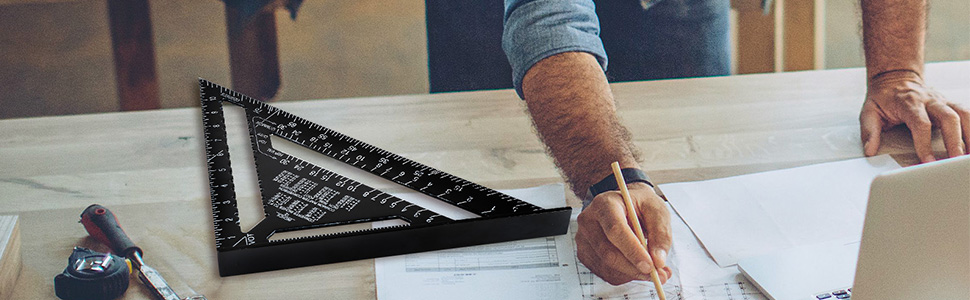
A speed square is one of the most versatile and essential tools for carpenters, builders, and DIYers. Whether you’re making quick 90-degree cuts, marking angles, or measuring roof pitch, a speed square can help you work faster and more accurately.
This guide will walk you through the key features of a speed square and the best ways to use it for woodworking, framing, and construction projects.
What is a Speed Square?
A speed square, also known as a rafter square or triangle square, is a multi-purpose measuring tool shaped like a right triangle. It combines the functions of:
✔ A try square for marking 90-degree angles
✔ A miter square for 45-degree cuts
✔ A protractor for measuring and marking angles
✔ A saw guide for making straight and precise cuts
✔ A rafter table for calculating roof pitch and rafter lengths
Speed squares are typically made of aluminum, steel, or plastic, and they range in size from 6 inches to 12 inches.
🔗 Find the Best Speed Squares on Amazon
How to Use a Speed Square for Accurate Measurements
1. Marking 90-Degree and 45-Degree Cuts
✔ For 90-degree cuts:
- Place the lip (fence) of the square against the edge of the wood.
- Draw a straight perpendicular line along the edge.
✔ For 45-degree cuts:
- Rotate the square until the angled edge lines up with the board.
- Mark along the hypotenuse for an accurate miter cut.
These simple but essential markings help in framing, deck building, and general carpentry.
🔗 Shop High-Quality Speed Squares on Amazon
2. Using a Speed Square as a Saw Guide
A speed square can double as a cutting guide when using a circular saw or jigsaw.
✔ Steps:
- Mark your cut line.
- Hold the lip of the square against the edge of the wood.
- Align your saw’s base plate against the square’s straight edge.
- Guide the saw along the square for a precise, straight cut.
This method prevents drifting and ensures clean, square cuts.
🔗 Check Out Durable Speed Squares on Amazon
3. Measuring and Marking Angles
A speed square includes a protractor scale along its long edge, allowing you to mark angles quickly and accurately.
✔ To mark an angle:
- Place the pivot point of the square at the edge of the board.
- Rotate the square until the desired angle on the protractor scale aligns with the board’s edge.
- Draw your line along the hypotenuse.
This is perfect for marking rafters, stair stringers, and angle cuts.
🔗 Shop Speed Squares with Protractor Markings on Amazon
4. Determining Roof Pitch
A speed square is an essential tool for roof framing.
✔ How to find the pitch of a roof:
- Place the lip of the speed square against the roof’s surface.
- Hold a level along the straight edge of the square.
- Read the angle where the square meets the level—this is your roof pitch (measured in inches of rise per 12 inches of run).
🔗 Find Speed Squares for Roof Pitch Measurements on Amazon
5. Measuring Rafter and Stair Layouts
Speed squares have common and hip/valley rafter scales for marking out:
✔ Roof rafters
✔ Stair stringers
✔ To mark stair stringers:
- Use the stair guides printed on the square.
- Align the square with the rise and run measurements.
- Mark each step’s cut lines accurately.
🔗 Shop Speed Squares with Rafter Guides on Amazon
Choosing the Right Speed Square
When buying a speed square, look for:
✔ Material: Aluminum or steel models last longer than plastic.
✔ Size: 6-inch squares fit in a pocket; 12-inch squares work better for framing.
✔ Markings: Look for clear and precise etched markings that won’t wear off.
✔ Additional Features: Some models include built-in levels, magnetic edges, and laser-etched guides.
🔗 Find the Best Speed Square for Your Needs on Amazon
Final Thoughts
A speed square is more than just a triangle—it’s a powerful tool for carpentry, framing, and layout work. Whether you need perfectly square cuts, accurate angles, or quick roof pitch measurements, a good speed square saves time and improves precision.
Looking for a Reliable Speed Square?
Browse top-rated models on Amazon and upgrade your toolkit today!


 Rex Rates
Leave a comment