
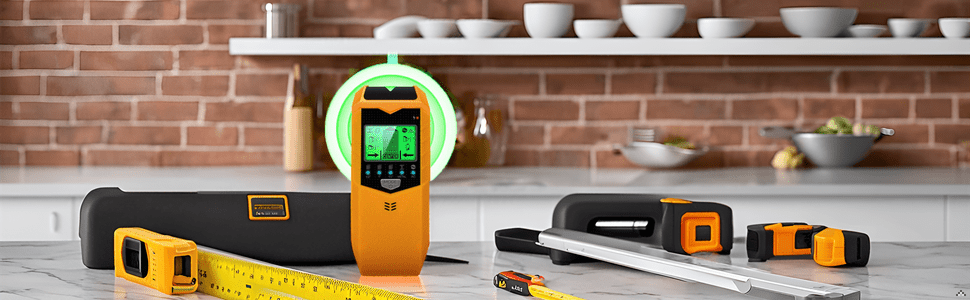
A stud finder is one of the most important tools for hanging shelves, mounting TVs, and securing heavy objects to walls. Without one, you risk drilling into empty drywall, leading to unstable installations.
In this guide, we’ll walk you through how to use a stud finder correctly, covering different types of stud finders, pro tips, and common mistakes to avoid.
1. Types of Stud Finders
Before using a stud finder, it’s important to understand the two main types available:
Magnetic Stud Finders
✔ Uses strong magnets to detect nails and screws in wooden studs
✔ No batteries required
✔ Simple but less accurate than electronic models
🔗 Shop Magnetic Stud Finders on Amazon
Electronic Stud Finders
✔ Uses sensors to detect density changes behind the wall
✔ More accurate and can identify stud edges and centers
✔ Some models also detect live wires and metal pipes
🔗 Find Electronic Stud Finders on Amazon
2. How to Use a Stud Finder
Step 1: Prepare the Wall
✔ Remove pictures, shelves, or any obstructions from the area
✔ Turn off nearby fans or AC units that could create vibrations
✔ If using an electronic stud finder, make sure the batteries are fresh
Step 2: Position and Calibrate
✔ Place the stud finder flat against the wall
✔ Turn it on and wait for calibration (for electronic models)
✔ Move it slowly in one direction
Step 3: Locate the Stud
✔ When the stud finder beeps or lights up, stop moving
✔ Move slightly backward to confirm the edge
✔ Mark the stud’s location with a pencil
Step 4: Find the Center of the Stud
✔ Continue sliding the finder to locate the other edge
✔ Mark the second point and measure between them
✔ The center of the stud is halfway between the two marks
🔗 Shop the Best Stud Finders on Amazon
3. Pro Tips for Accurate Stud Finding
✔ Always scan in multiple directions to confirm stud location
✔ Studs are typically 16 or 24 inches apart, so once you find one, measure across for others
✔ For extra accuracy, scan at least twice
✔ Avoid scanning too fast—slow movement gives better detection
✔ If mounting something heavy, use at least two studs for added support
🔗 Check Out Stud Finder Models with Deep Scanning on Amazon
4. Common Mistakes to Avoid
❌ Not checking for live wires – Some stud finders can detect electrical wiring, which is crucial for safety.
❌ Ignoring the second scan – Always verify your first reading by scanning again.
❌ Holding the stud finder at an angle – Keep it flat against the wall for the most accurate reading.
❌ Scanning over a textured or damp wall – Moisture or uneven surfaces affect accuracy.
🔗 Find Stud Finders with Wire Detection on Amazon
5. When to Use a Stud Finder
✔ Mounting TVs, heavy mirrors, or large artwork
✔ Installing shelves, cabinets, or towel bars
✔ Hanging curtain rods on drywall
✔ Avoiding electrical wires and pipes while drilling
If you’re working on any home improvement project that involves mounting, a stud finder is a must-have tool.
🔗 Browse the Best Stud Finders on Amazon
Final Thoughts
Using a stud finder correctly can save you time, prevent wall damage, and ensure secure installations. Whether you’re using a basic magnetic finder or a high-tech electronic model, taking your time to calibrate and scan multiple times will always give you the best results.
Need a Reliable Stud Finder?
Check out the best-rated options on Amazon and upgrade your toolbox today!
🔗 Shop the Best Stud Finders on Amazon
O



 Rex Rates
Leave a comment